Turning Amazon Reviews into Ad Angles for Ecom Brands
By Daniel, founder of Adlicio · Jul 21, 2026 · 7 min read
Amazon holds the largest continuously updated record of how buyers talk about products in existence. Millions of verified-purchase reviews, written by people with no reason to flatter you, sorted by the exact category you sell into. Most brands read their own star average and move on. The ad angles are in the text, and the best of them are on listings you do not even own.
Quick answer: To turn Amazon reviews into ad angles, read the review text rather than the star rating, focusing on four and three-star reviews where buyers explain both what worked and what almost stopped them. Pull reviews from competitor and category listings, not just your own, then group the language into angles (reasons to buy) and objections (reasons to hesitate) and rank each by how often the phrasing repeats. Verified-purchase reviews are honest and specific, which makes them a reliable source of hooks that sound like real customers because they are.
Why Amazon reviews are underrated for ad copy
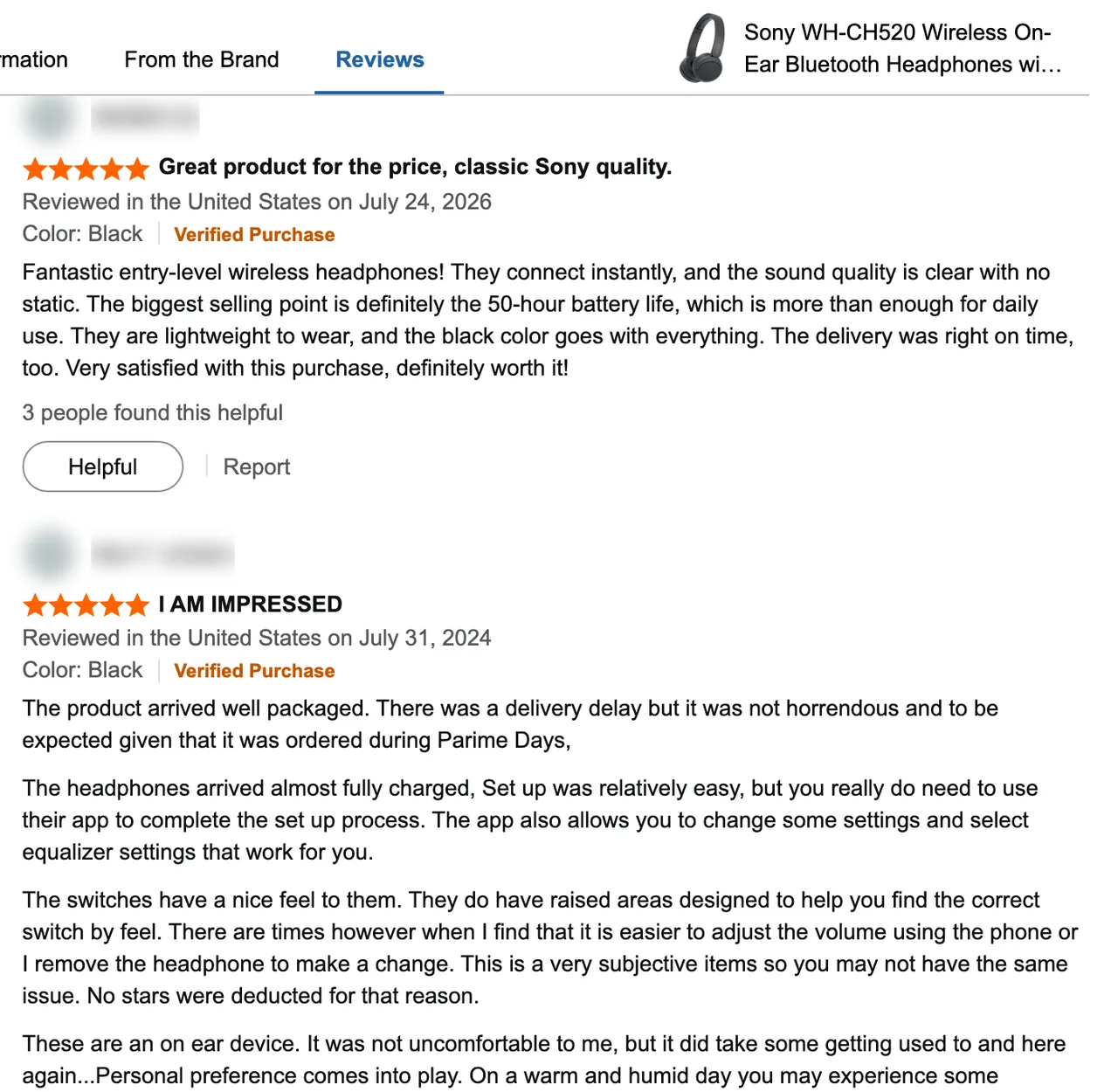
Amazon reviews have three properties that make them ideal ad research. They are verified, so the reviewer actually bought and used the product. They are structured, with a star rating, a title, and a body you can sort. And they are comparative, because buyers constantly mention what they tried before and why this was better or worse.
That comparison is where ad angles hide. "I switched from a name-brand version that cost twice as much and honestly cannot tell the difference" is a price-and-value angle handed to you fully formed. You are not inventing the claim; a verified buyer already made it.
Read the text, not the stars
The star average is a vanity metric for ad research. The language you want lives in the middle of the distribution:
- ✓Five-star reviews often say "love it, works great," which is warm but generic. Skim these for the occasional specific line.
- ✓Four-star reviews are the sweet spot. Buyers liked the product but name a caveat, which gives you both an angle and the objection to pre-empt.
- ✓Three-star reviews carry the sharpest mixed feelings. The buyer wanted to love it and explains exactly what held them back. That is your objection list.
- ✓One and two-star reviews show the failure modes to address or avoid claiming. On a competitor's listing, they are your positioning.
Sort by most recent as well as most helpful. Recent reviews reflect the current product and current buyer worries, which is what your ads need to speak to.
Read across competitor listings, not just your own
Your own reviews tell you what buyers think after they chose you. Competitor and category reviews tell you what the whole market wants and where rivals fall short. That second view is more valuable for acquisition, because it describes the buyer before they picked anyone.
Find the three or four best-selling listings in your category and read their three-star reviews. The repeated complaint across a category, a common flaw that no one has solved, is the cleanest ad angle available: you name the problem every competitor's reviews admit to, then show you fixed it. This is objection research at the category level, and it pairs directly with the method in extracting customer objections for ecom ad messaging.
Turning the reviews into ranked angles
Collecting reviews is the easy half. Ranking is what turns a pile of text into a test plan:
- ✓Tag each useful line as an angle or an objection, and note the emotion behind it.
- ✓Rank by repetition. A benefit or complaint that shows up across dozens of reviews is a category truth, not one buyer's opinion.
- ✓Keep the verbatim phrasing. "It fit in my carry-on with room to spare" beats your paraphrase "compact and travel-friendly" every time.
From there you write hooks from the top-ranked lines and test the strongest first, the same ranking pass covered in ranking ad hooks from real customer language.
Why pulling Amazon reviews by hand does not scale
Reading one listing is fine. Reading four competitors across their recent and three-star reviews, then tagging and counting the language, is an afternoon of copy-paste that most teams do once and never repeat. Amazon also paginates reviews and loads them dynamically, so generic scrapers tend to grab the first page and stop. The research that would sharpen every ad becomes the task that never gets done twice.
How Adlicio pulls and ranks Amazon reviews
Adlicio is built to make review mining repeatable. It pulls real Amazon reviews from any product and turns them into ad angles in your customers' own words, browser-based, with no Amazon API and no seller account required. It reads across the reviews, then ranks the language into angles, objections, and hooks ready for ad copy.
Amazon is one of 30+ platforms Adlicio covers, alongside Reddit, Google Reviews, TikTok, and Instagram, and it runs as an MCP connector inside Claude, ChatGPT, Perplexity, Grok, and Le Chat, or as a CLI tool, so the ranked language lands where you draft copy. More than 1,000 founders and operators use it today, alongside 7,500+ browser-extension installs, and the platform has collected over 7.2 million real customer comments across 87,000+ scrapes.
FAQ
Which Amazon reviews are most useful for ad angles? Four and three-star reviews. They name both what worked and what almost stopped the buyer, giving you an angle and the objection to pre-empt in the same review. Five-star reviews are warm but often too generic to quote.
Should I read my own reviews or competitors'? Both, for different jobs. Your reviews explain why buyers who found you chose you. Competitor and category reviews describe what the whole market wants and where rivals fall short, which is more useful for acquiring new customers.
Do I need an Amazon API or seller account to pull reviews? No. A browser-based scraper reads the review pages the same way a shopper does, so no API access or seller account is required. That also lets you read competitor listings you could never access through a seller account.
How do I turn reviews into actual ad copy? Tag each useful line as an angle or objection, rank by how often the phrasing repeats, and keep the verbatim wording. Then write hooks from the top-ranked lines and test the strongest first.
How often should I refresh this research? Every few weeks, or whenever you launch new creative. Recent reviews reflect the current product and current buyer concerns, so sorting by most recent keeps your ads speaking to today's objections.
Key takeaways
- ✓Amazon reviews are verified, structured, and comparative, which makes them a reliable free source of ad angles.
- ✓Read the review text, not the star average, and focus on four and three-star reviews.
- ✓Read across competitor and category listings; the repeated complaint no rival has solved is your cleanest angle.
- ✓Rank the language by repetition and keep the verbatim wording before writing hooks.
- ✓Manual review mining does not scale across competitors, which is why the collection step is worth automating.
Next steps
Pick your best-selling product and its three closest competitors on Amazon. Read the ten most recent three-star reviews on each, and copy every line that names a reason to buy or a reason to hesitate, keeping the exact words. Tag and count them, then write one ad that answers the most-repeated complaint across the category. To pull and rank reviews across those listings in about a minute, without an API or a seller account, run them through Adlicio.
About the author
Daniel is the founder of Adlicio. He builds the scrapers behind it and uses them daily to turn customer comments and reviews into ad angles.