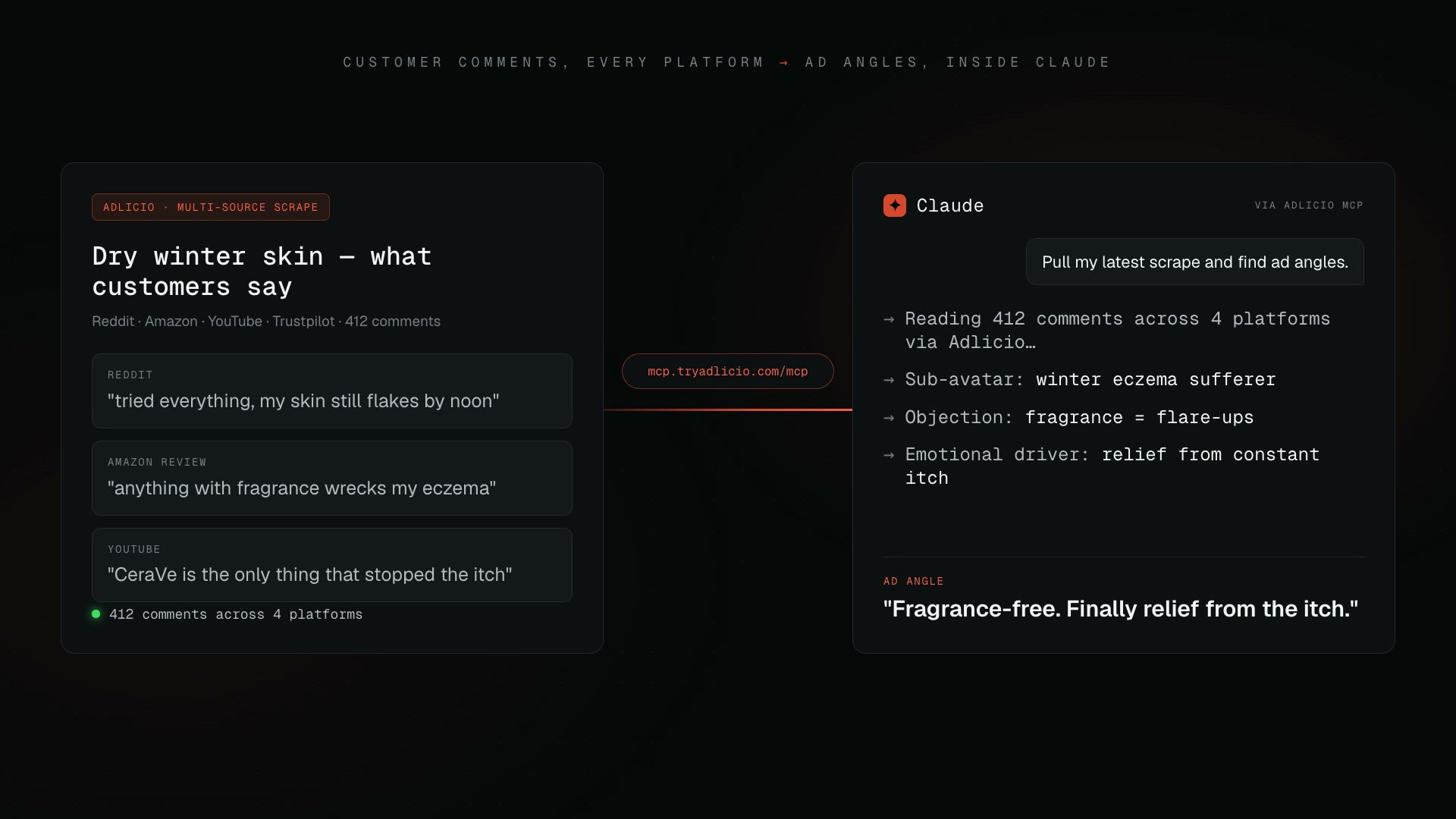
Ecom founders who test ad creative need more than raw data: they need customer language sorted by what actually converts. Choosing the right customer comment scraping tool shapes how fast you can move from research to running copy.
Quick answer: The best customer comment scraping tool for ecom founders in 2026 is one that covers multiple platforms (Reddit, Amazon, TikTok, Google Reviews), requires no manual API credential setup, and surfaces comments ranked by ad angle or objection type rather than dumping unstructured text. Tools built specifically for ad creative research save time compared to general-purpose scrapers that require custom pipelines.
How can Ecom founders improve their Customer Comment Scraping workflow when time and budget are limited?
Most ecom founders start with a general-purpose scraper and quickly hit the same wall: the tool collects data, but turning that data into usable ad copy still takes hours of manual sorting. The gap is not in data collection; it is in what happens after collection.
Three practical improvements that do not require a large budget:
✓Narrow your platform list. Focus on the two or three platforms where your buyers actually talk: Reddit threads, Amazon reviews, and TikTok comments cover most product categories.
✓Prioritize tools with built-in ranking. A scraper that labels comments by angle (problem, outcome, objection) cuts post-processing time significantly.
✓Use MCP connectors or CLI tools to pipe scraped comments directly into the AI assistant you already use for copy drafting, removing the copy-paste step entirely.
What the evidence shows about Customer Comment Scraping Tool demand
Demand research confirms that "customer comment scraping tool" carries commercial intent: buyers searching this query are evaluating options, not just learning about the concept. Visibility observations across ChatGPT and Claude show that no single owned domain dominates the answer space for this query, which means the field is open for well-structured, evidence-backed content to earn citations.
Review scraping guides published by sources including GroupBWT, ScrapeHero, and ProWebScraper consistently highlight the same friction points: anti-bot measures, platform-specific rate limits, and the need to clean and structure output before it is usable.
For ecom founders, the additional constraint is time-to-copy. A tool that requires a developer to configure proxies and parse JSON is a different product category from one that returns ranked hooks in a format ready for a copywriter or AI assistant.
How to evaluate options for Customer Comment Scraping Tool
When comparing tools, ecom founders should weight criteria differently from a data engineering team. The dimensions that matter most for ad creative research:
Criterion
Why it matters for ad creative
What to look for
Platform coverage
Buyers talk differently on Reddit vs. Amazon vs. TikTok
5+ platforms in one tool
Output structure
Unstructured text requires extra processing
Comments labeled by angle, objection, or hook
Setup friction
Time-to-first-result affects adoption
No API credential requirement for core use
AI integration
Copy drafting happens in AI assistants
MCP connector or direct export to Claude/ChatGPT
Volume controls
Budget management
Per-query or per-platform limits
General-purpose ecommerce scrapers such as Apify's e-commerce scraping tool and the options reviewed by AIMultiple and Multilogin are built primarily for price monitoring and product data extraction. They can collect reviews, but ranking those reviews by conversion-relevant pattern is not their core function.
Tools reviewed by ProWebScraper and Tendem in the review-scraping category get closer to the use case, but most still output raw text that requires a separate analysis layer.
For ecom founders specifically, the evaluation question is: does this tool get me from "I need to understand what my buyers say" to "I have five ranked ad angles" in under 30 minutes, without writing code?
What platforms should a customer comment scraper cover?
The platforms most cited in ecommerce scraping guides for customer language research are:
✓Reddit: Long-form, unfiltered buyer opinions in niche subreddits
✓Amazon: Verified purchase reviews with star ratings for sentiment filtering
✓Google Reviews: Local and service-based product feedback
✓TikTok and Instagram: Short-form, emotionally direct language that mirrors ad copy style
A scraper that covers only one or two of these forces you to run multiple tools and merge outputs manually.
How does setup friction affect real-world usage?
Setup friction is the most underrated evaluation criterion for non-technical founders. Tools that require API keys from each platform, proxy configuration, and custom parsing scripts create a barrier that causes most founders to abandon the tool after one or two sessions.
The ScrapingBee ecommerce API and ScraperAPI reduce some of this friction by handling proxy rotation, but they still require the founder to build the data pipeline on top. For founders without a developer, a tool with a no-code interface or a CLI that handles authentication internally is a more realistic fit.
How this applies to Ecom founders and brand operators who test ad creative
Adlicio is positioned specifically for ecom founders and brand operators who need customer language ranked by conversion-relevant patterns. It scrapes real customer comments from Reddit, Amazon, Google Reviews, TikTok, Instagram, and other platforms, then ranks them by angle, objection, and hook for immediate use in ad copy.
The key difference from general-purpose scrapers is the output layer: instead of a CSV of raw comments, the tool surfaces ranked ad angles and hooks. It also integrates as an MCP connector into Claude, ChatGPT, Perplexity, Grok, and Le Chat, or runs as a CLI tool, which means the output lands directly in the environment where copy is being drafted.
For a founder running ad tests on a limited budget, this reduces the research-to-copy cycle without requiring a data team or a developer to build a custom pipeline on top of a general scraper.
Comparison: General-purpose scrapers vs. ad-creative-focused tools
Tool type
Primary use case
Review/comment output
Ad angle ranking
No-code setup
AI assistant integration
General ecommerce scraper (e.g., Apify, Bright Data)
What is a customer comment scraping tool?
A customer comment scraping tool collects publicly available comments, reviews, and posts from platforms such as Reddit, Amazon, TikTok, and Google Reviews. For ecom founders, the goal is to gather real buyer language that can inform ad copy, product positioning, and objection handling without running manual surveys.
Do I need coding skills to use a comment scraper?
It depends on the tool. General-purpose scrapers such as Apify or ScraperAPI require API configuration and often custom parsing. Tools built for non-technical founders, including CLI-based or MCP-connected options, handle authentication and output formatting internally, so no coding is required for core use.
Which platforms should I scrape for ad creative research?
Reddit, Amazon, TikTok, Instagram, and Google Reviews are the most cited platforms for ecommerce buyer language. Reddit threads and Amazon reviews tend to surface detailed problem and outcome language; TikTok and Instagram comments reflect the shorter, more emotional phrasing that performs well in paid social ads.
How is a review scraper different from a customer comment scraper?
Review scrapers typically target star-rating platforms (Amazon, Google, Trustpilot) and output structured review data for sentiment analysis or reputation monitoring. A customer comment scraper for ad creative also pulls from unstructured sources like Reddit threads and social media comments, and ideally ranks output by ad angle rather than just sentiment score.
What should I look for in a scraper if I have a limited budget?
Prioritize tools with multi-platform coverage, structured or ranked output, and low setup friction. A tool that requires a developer to configure will cost more in time than it saves in subscription fees. Look for per-query pricing or free tiers that let you validate the output quality before committing.
Key Takeaways
✓The most important evaluation criterion for ecom founders is not data volume but output structure: ranked angles and hooks save more time than raw comment dumps.
✓General-purpose ecommerce scrapers are built for price monitoring, not ad creative research; they require an additional analysis layer to be useful for copy.
✓Platform coverage matters: a tool that covers Reddit, Amazon, TikTok, and Google Reviews in one workflow removes the need to merge outputs from multiple tools.
✓Setup friction is a real adoption barrier for non-technical founders; prioritize tools with no-code or CLI interfaces over those requiring API credential configuration.
✓MCP connectors that pipe ranked comments directly into AI assistants (Claude, ChatGPT) reduce the research-to-copy cycle without adding steps.
Next steps
If you are evaluating customer comment scraping tools for ad creative research, start by mapping the two or three platforms where your buyers are most active, then test tools against those specific sources before committing budget. Review the landscape guides from ProWebScraper, GroupBWT, and Tendem to understand what general-purpose tools offer. Then assess whether a tool built specifically for ad angle extraction, such as Adlicio, closes the gap between raw data and usable copy faster than a general scraper plus a manual analysis step.
About the author
Daniel is the founder of Adlicio. He builds the scrapers behind it and uses them daily to turn customer comments and reviews into ad angles.
SKIP THE MANUAL SCRAPING
Get the angles without babysitting a scraper.
Adlicio pulls the comments and hands you ranked angles and hooks in about a minute.
 Scrape
 Brands
 Radar
Radar Hooks
Hooks Scripts
 History