 Scrape
 Brands
 Radar
Radar Hooks
Hooks Scripts
 History
How to scrape Steam reviews
By Daniel, founder of Adlicio · 4 min read
Quick answer
Steam has an open appreviews endpoint, but it hands you raw JSON. Here are the real routes to Steam reviews and how to pull a game's reviews as ranked angles.
Steam is unusual: it actually has an open door. The public appreviews endpoint returns a game's reviews as JSON without an API key or an approval process, so the developer route here is genuinely open, unlike most platforms. The catch is not access, it is what you do with a wall of Recommended and Not Recommended verdicts once you have them.
Steam reviews are long, funny, and brutally honest, written by players who are hundreds of hours in. Here is how each route holds up, from copying by hand to the open endpoint to turning the whole review body into ranked ad angles in about 60 seconds.
★ 4.6 on the Chrome Web Store · no card needed
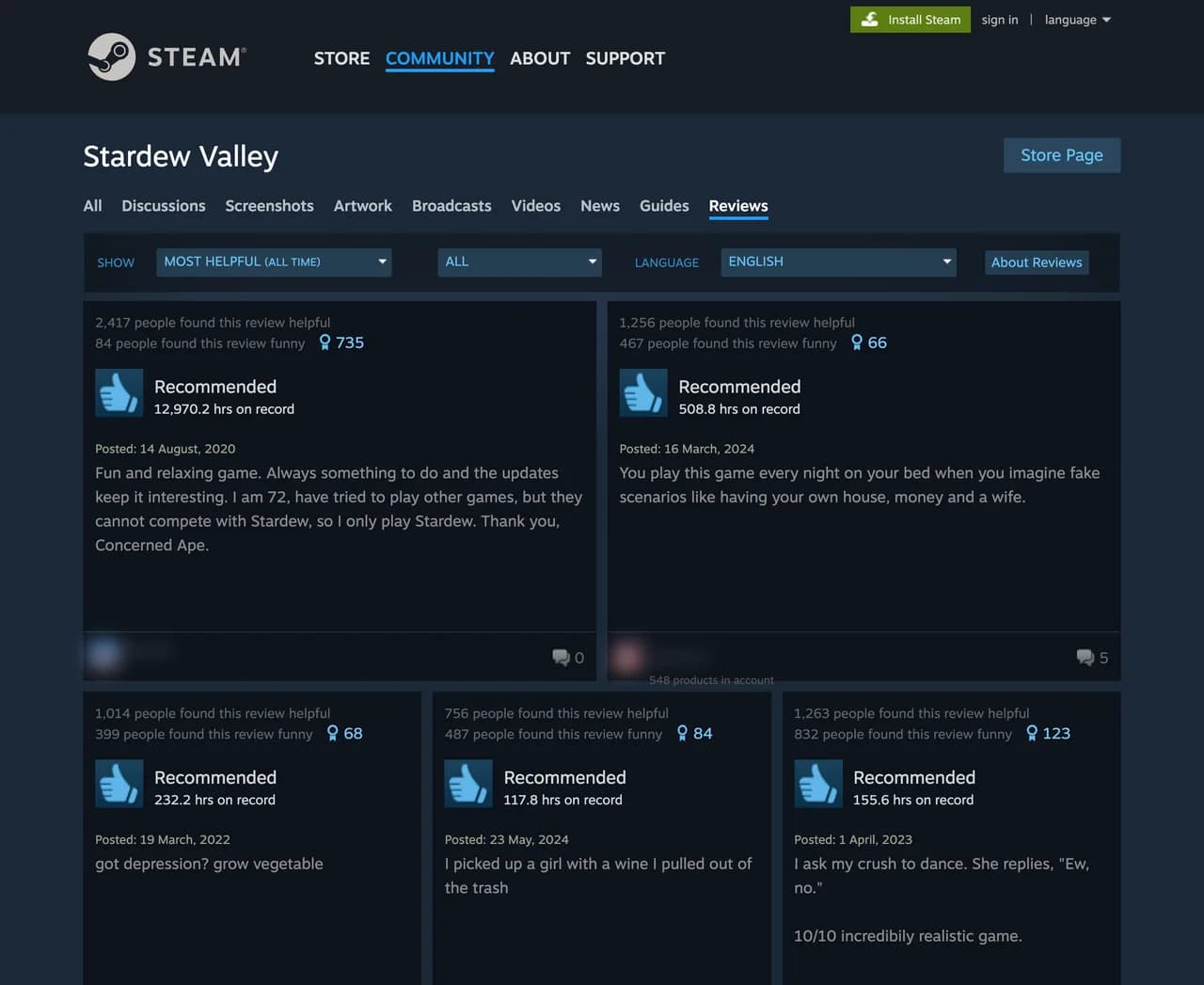
The manual route: fine for a skim, brutal at scale
Open a game's page, click into the reviews, filter by Recommended or Not Recommended, and read. For a gut check on one title this works, and Steam reviews reward reading because they are detailed and blunt. It falls apart on a popular game with tens of thousands of reviews, where the pattern you need is spread across pages you will never scroll to. You end up reading the same helpful reviews Steam surfaces first, which is the part every competitor already saw.
The public appreviews endpoint: open, but raw
Steam publishes a public appreviews endpoint that returns a game's reviews as JSON, no key required, paged with a cursor. This is a real gift and it is worth knowing about. What it does not do is any of the analysis. You get raw review text, the Recommended or Not Recommended verdict, and hours-played numbers in the payload, and then you own everything after that: pagination, deduplication, and the actual work of clustering thousands of verdicts into reasons people recommend a game and reasons they quietly refund it.
So the honest gap on Steam is not access, it is volume analysis and context. Turning that JSON into hours-played-weighted angles is a project on its own, and if games research is not your product, it is a project you probably do not want to build.
The paste-a-URL route
Adlicio reads the reviews on a public Steam page through your own browser session and finishes in about 60 seconds, no endpoint to parse and no cursor to page. More usefully, it does not stop at collection: the reviews come back clustered into ranked angles, the recurring praise, the complaints, and the moments that earn or lose a recommendation, each with the verbatim player quotes behind it.
Not Recommended reviews get weighted alongside the Recommended ones, which matters here: the refund stories and the it-clicks-eventually complaints are usually where your next angle lives. The raw reviews stay exportable.
The 60-second version
- 01Pick titles where your players are vocal
Your own game, the genre leader, and the rival you lose wishlists to. High review counts mean more honest language to work from.
- 02Paste the Steam page URL into Adlicio
Any public store or community page. The scrape reads across the public reviews and finishes in about 60 seconds.
- 03Read the clusters, lift the player voice
Work from the ranked angles: the recurring complaint becomes your hook, the verbatim review becomes your proof line. Reviews that earned a Recommended are the rawest copy you can get.
Questions people also ask
Is there a free Steam reviews API?+
Yes, sort of. Steam's public appreviews endpoint returns a game's reviews as JSON without a key, so the raw data is genuinely open. It gives you text, the recommended verdict, and hours played, but no analysis, so you still have to page, dedupe, and cluster everything yourself.
Can I see hours played on each Steam review?+
The hours-played context is part of what makes Steam reviews trustworthy, so it is worth keeping. Adlicio reads the public reviews with that context intact, then weights the recommendation patterns so a two-hundred-hour recommendation carries more than a twenty-minute refund.
How do I turn Recommended and Not Recommended reviews into ad angles?+
That is the real work, and it is what Adlicio automates. Instead of two undifferentiated walls of verdicts, you get the recommendations grouped into the reasons players stay and the not-recommended reviews grouped into the objections costing you sales, each with the quotes behind it.
Are funny Steam reviews any use for ad copy?+
They are some of the best raw material there is. A blunt, funny one-liner that a player wrote unprompted already survived the scroll, so the phrasing tends to make sharper hooks than anything written to sell.
About the author
Daniel is the founder of Adlicio. He builds the scrapers behind it and uses them daily to turn customer comments and reviews into ad angles.
More guides
Steam scraperAll scrapersSee pricing
Run this play on your own Steam page.
Paste one public URL. Adlicio returns the angle, hook, and proof to test next.