 Scrape
 Brands
 Radar
Radar Hooks
Hooks Scripts
 History
How to mine Amazon reviews for ad angles
By Daniel, founder of Adlicio · 2 min read
Quick answer
Competitor reviews are a free focus group. How to mine Amazon reviews for the desires, objections, and verbatim phrases that become high-converting ad angles.
An Amazon review is a customer explaining, unprompted and in their own words, why they bought, what almost stopped them, and what the product actually did for them. Multiply that by a few hundred reviews and you have a focus group that already ran, for free, on your competitor's listing.
Mining it means going from 'I read some reviews' to a ranked list of angles with proof. Here is the method.
★ 4.6 on the Chrome Web Store · no card needed
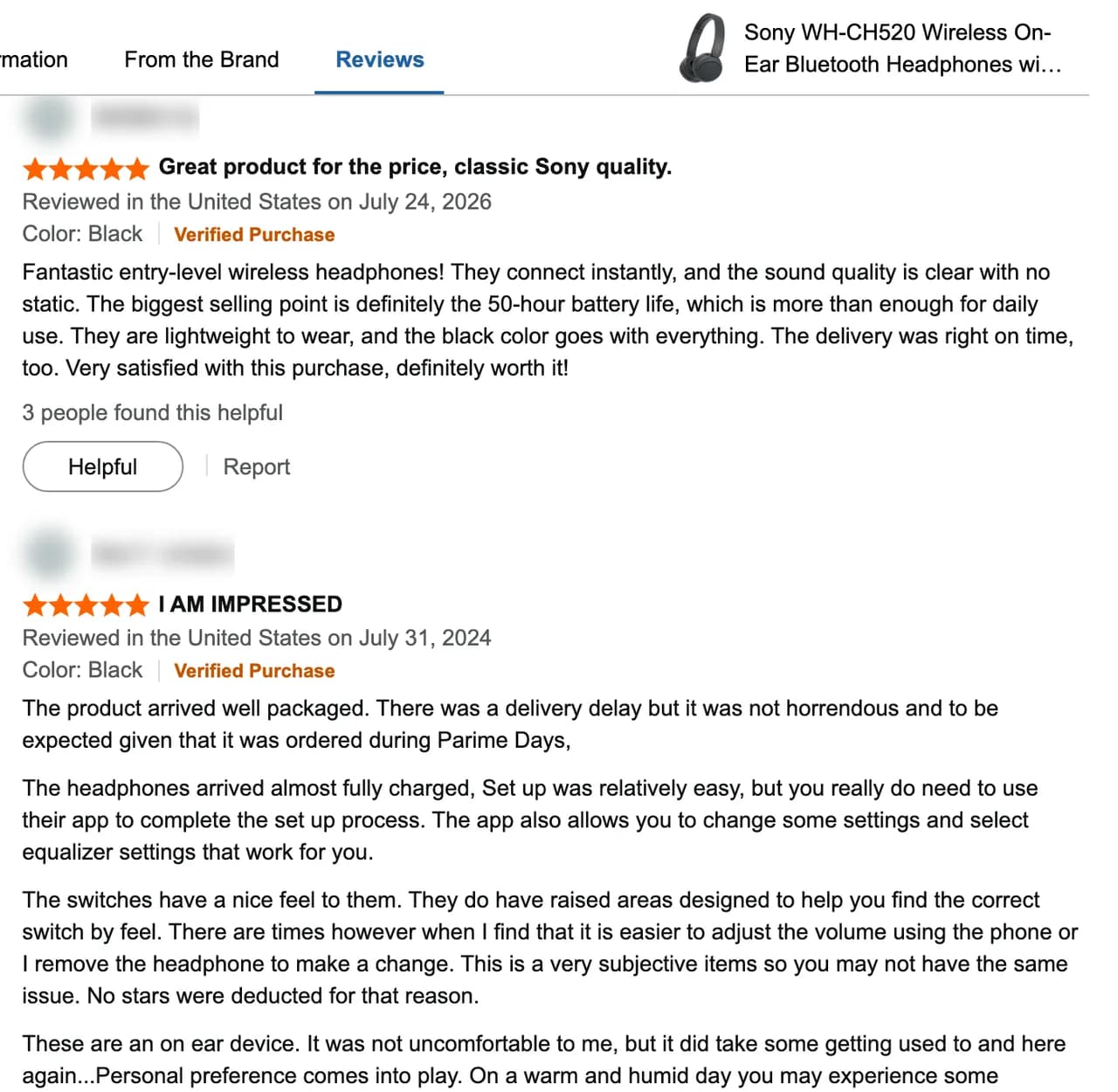
Read the star ratings as layers, not scores
Each rating band answers a different research question. Five-star reviews tell you the outcome that delighted people and the words they reach for when recommending. One-star reviews tell you the failure modes and the fears a new buyer brings. Three-star reviews are the honest middle: 'good but', which is where positioning against a competitor usually starts.
- Five-star: desire language and the moment of payoff. Your outcome hooks.
- One-star: objections, broken promises, disappointments. Your proof hooks and your 'unlike the one that broke' angles.
- Three-star: trade-offs and comparisons. Your differentiation copy.
What counts as an angle
An angle is a reason to buy, stated as the customer feels it, not a feature. 'Stainless steel construction' is a feature. 'The third one I bought this year because the cheap ones keep snapping' is an angle: durability framed as money already wasted. When a phrasing pattern shows up across dozens of reviews, you have found a reason to buy that the market has already validated.
Let the clustering do the counting
Tallying themes across 400 reviews by hand is an afternoon of spreadsheet work per product. Adlicio does it in about 60 seconds: paste the product URL and the reviews come back clustered into ranked angles, each with a hook line and the verbatim quotes that back it.
Run it on your own product and your competitor's. The gap between the two clusters is your positioning: the pain their buyers report that your buyers do not is the strongest ad you can write.
The 60-second version
- 01Scrape your product and 2-3 competitors
Paste each Amazon URL into Adlicio. Around 60 seconds per product, and every scrape stays in your history.
- 02Compare the top clusters across products
Look for objections your competitors' buyers raise that yours do not, and desires everyone shares. Both are angles.
- 03Write ads from the verbatim quotes
Lead with the customer's phrasing, not your rewrite of it. The review language is what makes the ad feel true.
Questions people also ask
Should I mine my own reviews or competitors'?+
Both, and compare them. Your reviews tell you what to promise; competitor reviews tell you what doubts to answer and which failures to position against.
How many reviews do I need for reliable angles?+
Patterns stabilize around a couple hundred reviews. Below that, treat the clusters as hypotheses and validate with a second product or a Reddit thread in the same category.
Can I do this for products outside my niche?+
Yes, and it is a common agency workflow: mine the category leader's reviews before a client pitch so the angles arrive already backed by customer quotes.
About the author
Daniel is the founder of Adlicio. He builds the scrapers behind it and uses them daily to turn customer comments and reviews into ad angles.
More guides
Amazon scraperAll scrapersSee pricing
Run this play on your own Amazon page.
Paste one public URL. Adlicio returns the angle, hook, and proof to test next.